
June 2026 Newsletter
WELCOME FROM OUR CHAIRS
During our recent exhibition, Dictionary, we worked with photographer Jonathan Dredge, who recorded a series of conversations with members about their work.
It was a real pleasure working with Jonathan, who immediately made everyone feel comfortable in front of the camera and created an atmosphere where artists could speak openly and naturally about their practice.
The conversations explore the ideas and concepts artists took from the exhibition title, Dictionary; how working in response to a shared theme pushed their work into new directions; and the relationships between materiality, process, and technique within their practice.
Below, you will find nine reels featuring nine members speaking in detail about their work. We hope you enjoy watching them as much as we enjoyed making them.
With best wishes,
Wolfgang Woerner, Chair
Jane Riley, Vice Chair
JUNE INSTAGRAM REELS
WATCH EVERY TUESDAY AND THURSDAY AS OUR MEMBERS DISCUSS THEIR EXHIBITION WORK
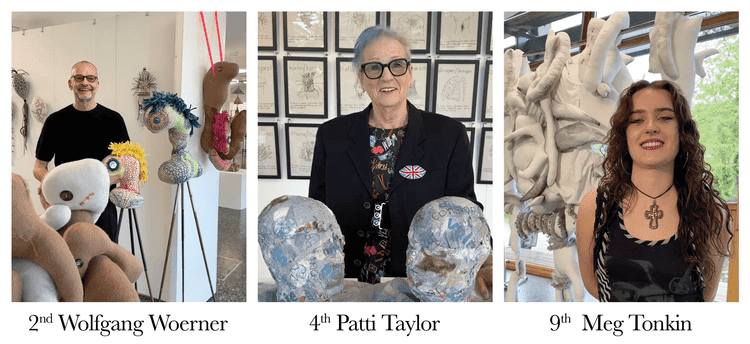
2nd JUNE Wolfgang Woerner
Wolfgang’s work explores personal and collective space, recording fleeting impressions, physical traces, and emotional states. Each piece reflects a dialogue between material and memory. The Etymologies and Inflected Forms Project treats textiles as a living lexicon. Like words in a dictionary, fragments of cloth are catalogued, grouped, and reinterpreted through soft sculpture and embroidery. Blanket stitch provides an armour-like protection to some of the specimens. Traditionally used to bind edges and prevent fraying, the stitch echoes ancient styles of written language such as Ogham. In contrast others are left naked and exposed alluding to a sense of vulnerability.
4th JUNE Patti Taylor
Patti is a multidisciplinary artist whose practice is rooted in narrative. A wry, humorous outlook often underpins her work, allowing complex or uncomfortable subjects to be approached with lightness and subtle irony. In Sensarium, Patti creates a speculative lexicon for emotions and sensations with no place in the dictionary, pairing language with image. The works explore the unnameable: fleeting, awkward, or deeply felt experiences that resist conventional language. Conversation reflects on language and self-description. The work considers how friends and family recently described her; the heads appear puzzled, caught between these external definitions and her own sense of self.
9th JUNE Meg Tonkin
Meg, a BA Fine Art student from Central Saint Martins, is currently doing her Diploma in Professional Studies through Prism Textiles’ new mentoring programme. She is fascinated by the intersection between the natural and the man-made world and also invertebrate anatomy (especially the study of her pet stick insects). Her approach to Dictionary was inspired by her name and she landed unsurprisingly on the prefix “Mega”. Megabit, Megatsunami, Megastore. Deciding to make something of her own MEGA, she zoomed in on features of insects to scale up, eventually finding a fungus, and so Megacordyceps was created.
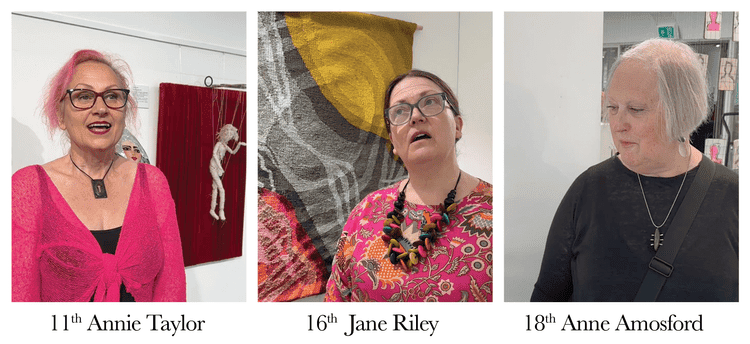
11th JUNE Annie Taylor
Annie is an artist of whom it has often been asked “has she nothing better to do?” as she creates fabric friends (soft sculptures) and stitched stories. Prone to falling down rabbit holes of the mind, opening a dictionary can sometimes be a dangerous undertaking. A habitual list maker, Annie struggles to focus without a To Do List, and began this work somewhat listless of mind and spirit. Her usual practice begins with sketch and concept; in building these figures purely out of the scrap basket, listening to their story as she stitches, these pieces are a change in direction.
16th JUNE Jane Riley
As a weaver Jane draws on many carefully honed techniques to describe her chosen subject; this she likens to a vocabulary, first basic, becoming increasingly sophisticated. For 10 years, she has studied marine algae, using yarn to describe each species in its dry or submerged state. For this exhibition Jane has chosen to produce a series of works exploring an encrusting coralline seaweed, commonly known as Pink Paint. She uses colour texture and pattern to respond to its particular characteristics. Her yarn palette for Dictionary is consistent for each work.
18th JUNE Anne Amosford
Anne draws inspiration from a diverse range of sources, including inanimate objects, overheard conversations, or even the title of an exhibition proposal. In this context, she selected two quotations related to Dictionary as her conceptual foundation. The first, by Michael Clark, ballet dancer, and the second by Henrietta Ludovica Wijnande Marianne Müller, the wife of Abraham Caland who was a contributor to the first Oxford English Dictionary. While maintaining an appreciation for unconventional perspectives, Anne employs both traditional techniques and new methods to achieve the desired results.
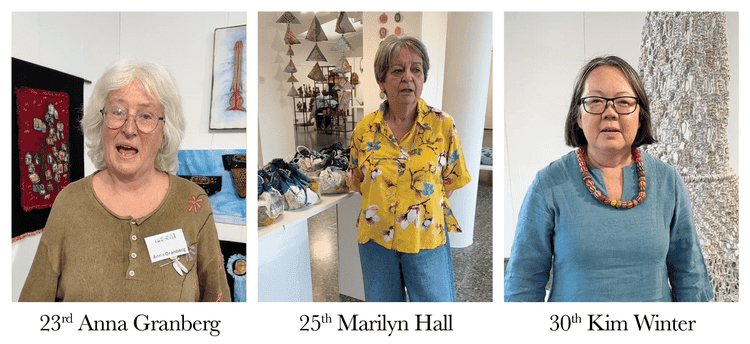
23rd JUNE Anna Granberg
Anna is a Swedish artist, educated at Opus School of Textile Art. For Anna, textiles are the ultimate way of utilising materials for her expressive art. Her works pose questions around what’s happening in the world today and how it influences life. The world is constantly changing, and Anna thinks that it is important to be aware of what changes you want to have in society. She explores this by employing old and sometimes unexpected materials in different ways to express colour and form, using family history and textiles as her sources.
25th JUNE Marilyn Hall
Marilyn’s work continues to reference and honour people from the past. Inspiration for Dictionary was difficult to find until a chance encounter. Whilst researching a family member who emigrated to Australia in 1921, Marilyn came across an online reference book: the Australian Dictionary of Biography. Not many women are mentioned in the dictionary; however, those who are have a fascinating history which helped shape present-day society of Australia—first nation Aboriginal women, wives and daughters of male settlers and transported convict women. Marilyn’s work focuses on convict women sent to Australia to provide breeding stock for the new colony.
30th JUNE Kim Winter
Kim uses traditional basketry techniques to create contemporary sculptural pieces. Sometimes these are functional vessels, but mostly they are artworks—she loves the challenge of pushing the boundaries to make original basketry forms. Inspired by the Tower of Babel, Kim has used the pages from foreign language dictionaries to make cordage, from which she has constructed her works in this exhibition. Learning other languages gives you insight into other cultures, helping you build better connections. But does the convenience of using instant translation apps on our phones mean we are missing out on the rich context that physical dictionaries offer?
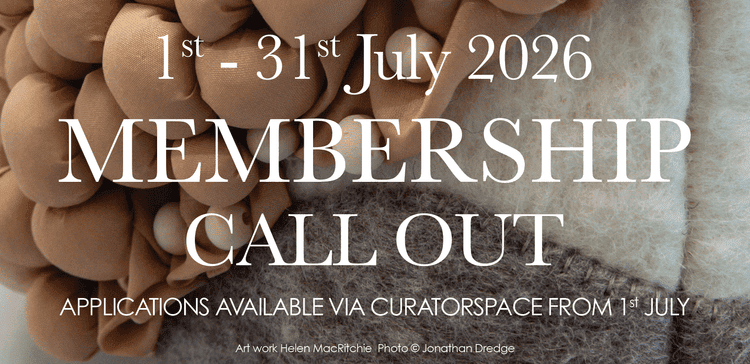
PRISM NEW MEMBER CALL OUT 1st - 31st JULY
Applications available via CuratorSpace from 1 July
We hold membership callouts every two years. You can find out more about our group and our mission by clicking here. PRISM is a well-established group of textile artists, set up to give opportunities to exhibit at a professional level. This opportunity is open to all artists using textiles as a part of, or major influence in, their work.
Membership is maintained by successful submission of work for group exhibitions, renewal of annual membership fee and active participation in the life of the group.
Please remember that your commitment as a member will involve you not only in exhibiting on a regular basis, but also offering the group your time towards administration, publicity, setting up exhibitions, stewarding etc…
PRISM at KNIT+ STITCH
8th - 11th OCTOBER 2026
Alexandra Palace, London
19th - 22nd NOVEMBER 2026
Harrogate Convention Centre
SEE YOU THERE